In the kitchen
Look for pooled water, stacked pieces, and scorching patches; address the visible problem before changing the burner.
Look, listen, check
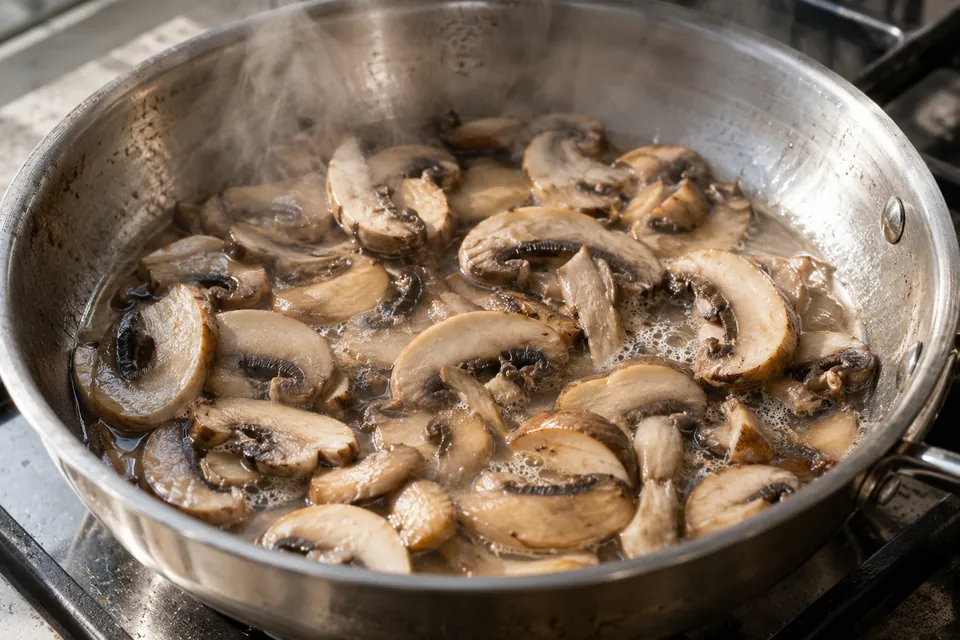
- Pooled water bubbles while some contact surfaces remain pale.
- Exposed patches may scorch before wet areas brown.
- A reducing sauce loses volume and needs more frequent checks near the end.
In this guide
Read the pan
A hot burner does not tell you the temperature of every patch of food. Look at where food touches the bottom, where liquid sits, and where residue is exposed.
For Food Is Steaming Instead of Browning, check space and pooled water first. For a sauce, decide whether losing water will improve both texture and flavor.
The physics
Heat travels through the pan and into contacting food. Material, thickness, and temperature differences affect that transfer; OpenStax’s conduction chapter explains the underlying principles. Food above a heap has a different contact situation from food spread over the bottom.
Water also needs energy to become vapor. During boiling at ordinary sea-level pressure, pure liquid water stays near 100°C / 212°F while added energy drives the phase change. OpenStax’s phase-change chapter explains this. Dissolved ingredients, pressure, and altitude can change the boiling point; a whole pan of food is not uniformly at that temperature.
The practical result is local: a wet area and an exposed dry area can behave differently, even in the same skillet.
What to change
- If pieces are stacked, spread them out or use smaller batches.
- If water is pooling and browning is the goal, leave the pan uncovered and allow evaporation, while watching exposed residue.
- If only some areas are scorching, lower heat or reposition the food rather than increasing heat everywhere.
- If the food is already cooked as far as you want, accept less browning rather than drying it out.
Change one visible problem at a time, then check the pan again rather than treating the burner label as a measurement.
Where it shows up
Sear needs useful surface contact. Sauté must manage both turning and water release. Deglaze intentionally introduces liquid to recover residue. Pan Sauce then uses evaporation to concentrate that liquid.
A lid can be useful when moist cooking is intentional. Steaming is a technique, not a failure in every dish.
Failure modes
Persistent pooling can produce pale food; exposed residue can still become Burnt Pan Drippings. During reduction, declining volume makes it easier to overshoot your target.
Thin Pan Sauce asks whether further concentration is desirable. A vigorous boil is not a shortcut to knowing the right flavor or final consistency.
Sauce Body separates water loss from the ingredients and serving temperature that also affect flow. Reduction remains a contextual method here, not a guarantee of spoon-coating thickness.
The Maillard Reaction page handles browning chemistry. Surface activity does not prove safe meat doneness: USDA guidance requires a food thermometer, not a judgment based on color or sizzling.