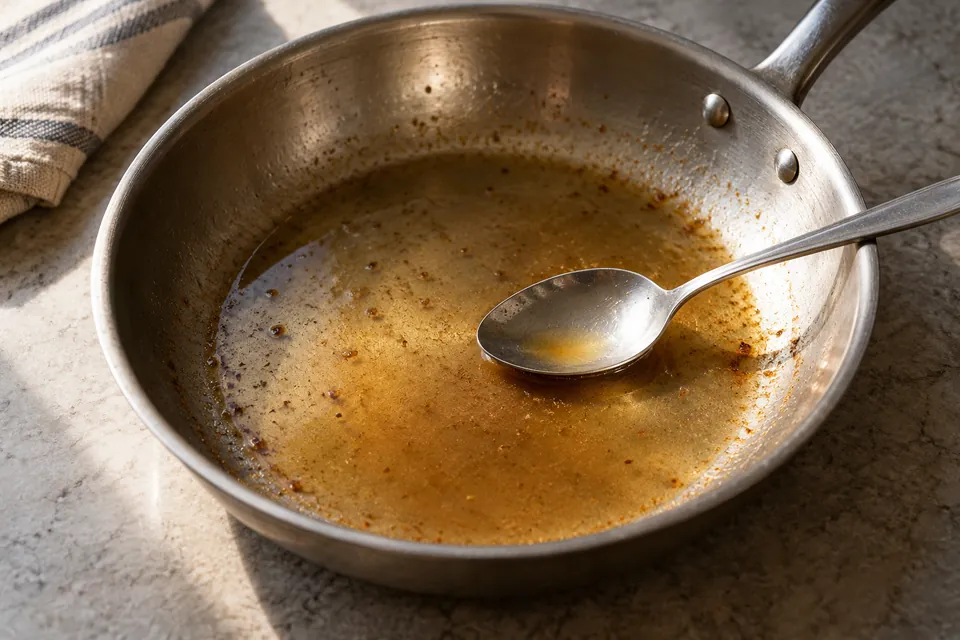
In the kitchen
Taste a cooled spoonful of the cooked sauce before reducing further; stop if the flavor is already concentrated enough.
Look, listen, check
- A light jus can pour freely and still be finished.
- Reduction lowers volume while increasing flavor intensity.
- A separate oily layer is not the same problem as watery liquid.
In this guide
What happened
The sauce runs off the spoon or spreads across the plate. First decide whether that is a problem: a light jus is supposed to flow. You need a rescue only if the texture does not suit the food.
Visible beads or a layer of oil suggest a different issue. Boiling away more water is not a universal answer to separated fat; Butter-Finished Sauce Is Oily covers that observation in butter-finished liquid sauces.
How to fix it
- Taste a spoonful of the cooked sauce after cooling it enough to taste.
- If it is both watery and weak, simmer uncovered and check it frequently as the volume falls.
- If it is already salty or strongly flavored, stop reducing. Serve it as a lighter sauce, or restart with less-seasoned liquid if a thicker result matters.
- If a butter finish suits the dish, remove the pan from heat and stir in small pieces gradually. Stop if oil begins to separate. Do not add a large amount of butter to compensate for a panful of excess liquid.
- Check the sauce’s flow after a spoonful cools slightly, not only while it is boiling.
These are decisions, not promises that every stock will become spoon-coating. A sauce can improve without reaching the texture you originally pictured.
Why this happens
Evaporation removes water; the remaining liquid becomes more concentrated. OpenStax’s phase-change explanation supports the evaporation mechanism. Illinois Physics Van explains why salt is left behind as water evaporates. Taste before reducing further: an already seasoned sauce can become too salty.
Different stocks and finishing ingredients produce different textures. ChefSteps describes the role of gelatin in pan-sauce body; a gelatin-rich Stock is one option to plan for next time. A “reduce by half” instruction does not guarantee a particular consistency. Sauce Body helps choose the intended result. All-Clad’s guide treats butter finishing as a step after reduction, which helps distinguish the two decisions.
How to prevent it next time
Add liquid with the intended serving volume in mind. Use less-seasoned stock when you expect substantial reduction, and finalize salt later.
Know whether you want a pouring jus or a coating sauce before chasing thickness. Avoid reducing the whole meal in the pan to fix the sauce: remove properly cooked food first.
For leftover sauce, follow USDA reheating guidance, including bringing sauces to a boil, before any fresh finishing step.
Related failures
Burnt Pan Drippings requires a clean flavor foundation. Thickness cannot compensate for acrid residue.
See also
Pan Sauce provides the full sequence. Deglaze is only the recovery step; Heat and Moisture explains what changes during reduction.