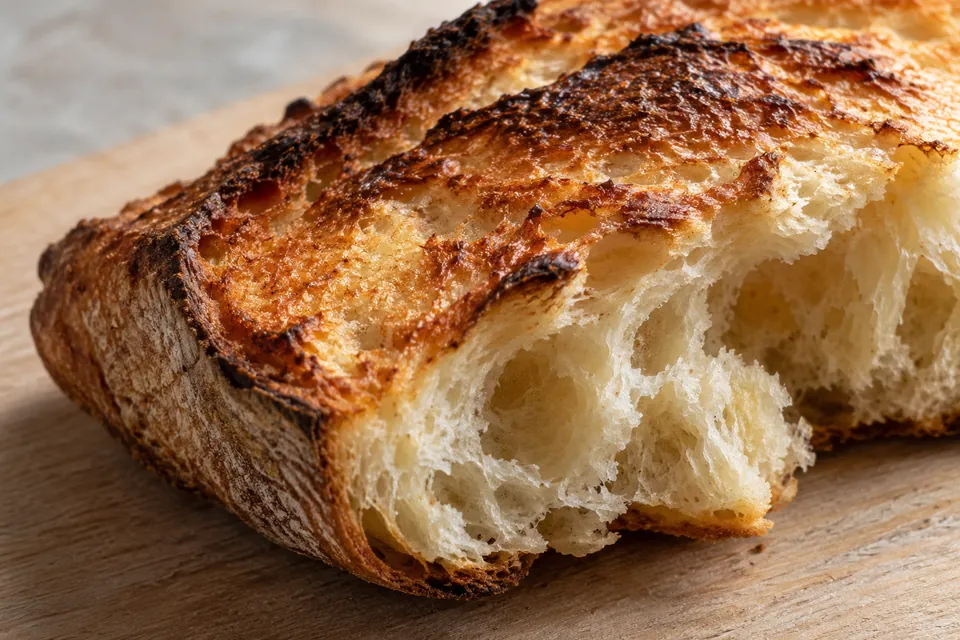
In the kitchen
For a better brown surface, improve dryness and contact before reaching for more heat or additives.
Look, listen, check
- A roasted aroma and a brown contact surface are useful flavor cues.
- Wet and dry areas of the same pan can behave differently.
- Neither a browned crust nor its aroma proves safe internal doneness.
In this guide
Use the idea
When food stays pale, ask what is happening at its surface. Is it wet? Does it contact the pan? Is the residue burning elsewhere? Change the condition you can see instead of treating “more heat” as the whole answer.
Sear and Sauté give the practical steps. This page explains why those steps can produce a different flavor from simmering the same ingredient.
The chemistry
Reducing sugars react with amino groups, including those in amino acids and proteins. Subsequent reactions create many aroma compounds and pigments. It is a family of pathways rather than one change with one flavor. Modernist Cuisine explains the connection between these reactions and browned-food aromas.
The ingredients already contain reactants; sprinkling sugar onto meat is not a prerequisite. It can instead introduce a coating that needs closer attention during cooking.
No single switch temperature
Temperature changes reaction speed, but so do the food’s composition, acidity, moisture, and time. A universal “Maillard starts at this temperature” rule is too strong.
Warmbier, Schnickels and Labuza’s published abstract reports Maillard browning in a casein, glucose, and glycerol model at much lower temperatures than a searing pan. That establishes that high pan temperature is not a universal chemical prerequisite. It does not establish useful cooking times for your food.
For everyday pan browning, drying a wet contact surface matters. Heat and Moisture explains the evaporation constraint without claiming that water switches every Maillard reaction off.
How it differs from caramelization
Caramelization involves changes in heated sugars; Maillard chemistry involves amino groups as well. The Exploratorium’s candy explanation distinguishes them. Both processes can contribute to a food, so “brown” is not enough to identify a single reaction.
Nor does every kind of browning belong here: a cut ingredient darkening during storage is a different question from a browned cooking surface.
Where it shows up
Searing and sautéing create browned surfaces. Deglaze recovers usable browned residue, and Pan Sauce carries that flavor into a liquid. The last two use reaction products already made; they do not require the sauce itself to form a new crust.
Failure modes
Food Is Steaming Instead of Browning points to conditions that hinder the result you want. Burnt Pan Drippings calls for a different decision: additional darkening can damage flavor.
Crust color remains a flavor cue. USDA says color is not a reliable indicator of food safety; use an Instant-Read Thermometer for that question.