In the kitchen
Check flow near eating temperature and taste before changing concentration; a light jus may already be finished.
Look, listen, check
- A cohesive sauce and an oily sauce need different decisions.
- A cooled spoonful may flow differently from the bubbling pan.
- Strong flavor can arrive before spoon-coating thickness.
In this guide
Read the result
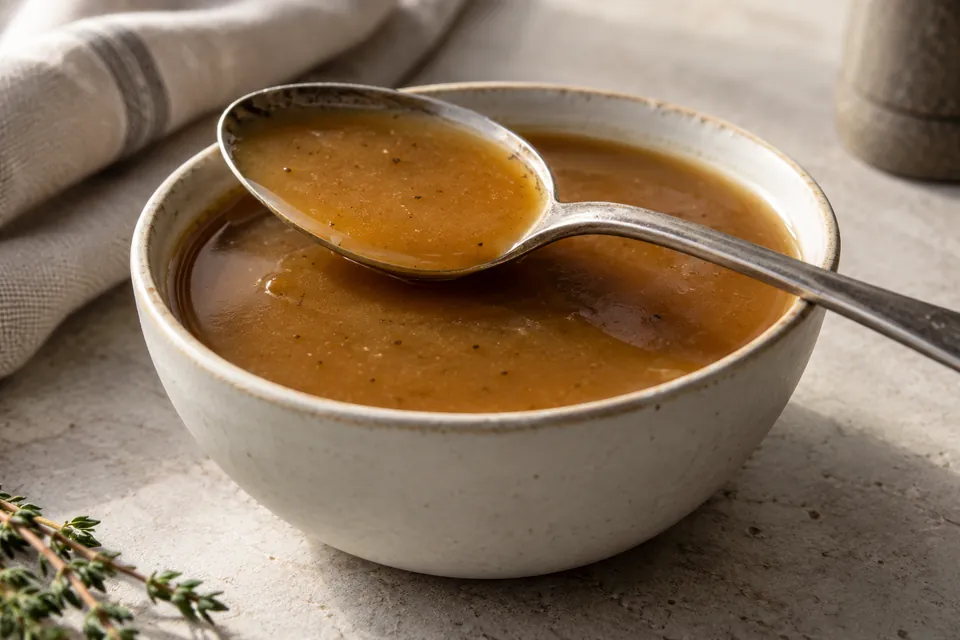
Choose the job before changing the sauce. A pouring jus, a dressing, and a sauce that coats cooked vegetables need not share one consistency. Judge a spoonful near eating temperature, not only while liquid is bubbling.
Ask three questions: Does it flow as intended? Is it mixed together? Does it taste appropriately seasoned? A single spoon-coating test cannot answer all three.
What contributes to body
Evaporation removes water, leaving a smaller volume. OpenStax’s phase-change chapter explains the energy needed for that evaporation. Illinois Physics Van explains why salt remains behind. Further reduction can make salt excessive before achieving the texture you wanted.
Ingredients also matter. ChefSteps’ public pan-sauce introduction identifies gelatin as a contributor to body and to a cohesive stock-based sauce. That does not mean every carton of stock contains useful gelatin or that every stock will thicken equally.
Temperature changes the result too. Gelatin in water can form a gel that melts again with warming, as explained in UCLA’s Science and Food gelatin discussion. A chilled gel and a hot pouring stock are therefore compatible observations, not proof that the cooking failed.
What to change
| Observation | Useful next question |
|---|---|
| Watery, cohesive, weak flavor | Would modest reduction improve this sauce? |
| Watery but already salty | Would further concentration make flavor worse? |
| Cohesive but too thick | Has it cooled, or does it need a little compatible liquid? |
| Distinct oil layer | Is this an emulsion problem rather than a thickness problem? |
These are starting questions, not promises of rescue. Thin Pan Sauce, Sauce Is Too Thick, and Butter-Finished Sauce Is Oily give bounded decisions.
Worked comparisons
Suppose two sauces each lose half their starting volume. One started with a gelatin-rich stock; the other with a light broth. The equal reduction does not establish equal body. Compare flavor and flow before reducing either further.
If your mushroom jus tastes balanced and pours freely, it can be finished. If you wanted it to cling more, that is a different preference, not evidence that every jus needs thickening.
Where it shows up
Stock helps choose the liquid base. Finish a Sauce with Butter changes the finish; Emulsions explains cohesion. Heat and Moisture explains water loss.
Limits
This guide does not prescribe roux, starch-slurry, cheese, or egg-sauce methods. Nor does thicker mean safer or more fully cooked. Use the applicable food-safety guidance independently of texture.