In the kitchen
Use a small cold piece of whole butter in an already flavorful warm liquid; taste before adding more, especially with salted butter.
Look, listen, check
- A small piece melts into the liquid without leaving a growing slick.
- Salted butter contributes seasoning as well as fat.
- The sauce need not become thick to have a useful butter finish.
In this guide
What butter is
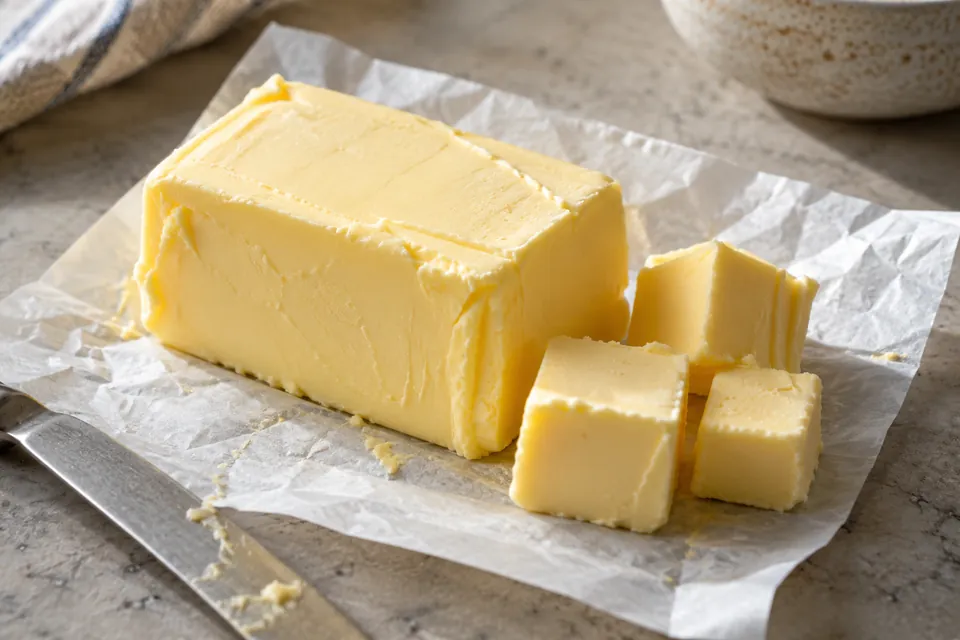
Whole butter contains fat and water, with milk solids and sometimes salt. Guelph’s dairy-science text describes it as a water-in-oil emulsion. That structure is different from the dispersed butterfat in a finished liquid sauce.
This guide uses ordinary whole dairy butter for Finish a Sauce with Butter. It does not treat every product labeled “spread” as interchangeable.
How to buy and store
Choose salted or unsalted according to the seasoning control you want. Unsalted is convenient when the liquid base is already seasoned; salted can work if you taste and account for its contribution. No premium-fat percentage or brand is required by this guide.
Keep butter wrapped or covered in the refrigerator and follow its package instructions. Land O’Lakes’ storage guidance recommends refrigeration for its butter. That manufacturer guidance is not a universal shelf-life promise for all butter products.
Cut a few small pieces for the finish and return the rest to refrigeration rather than softening the entire block for this method.
Functional role in techniques
Butter adds flavor and can make a cooked liquid feel richer when the fat disperses through it. Use it after the concentration decision, not as a substitute for one.
All-Clad’s finishing method adds small cold pieces off heat. Cold pieces and gradual additions make it easier to observe each addition in this method; they are not proof that every other butter technique must fail.
For a Pan Sauce, first assess the fond and free cooking fat. Whole butter is not the liquid that releases residue in the Deglaze method.
Worked choice
Your stock-based sauce tastes balanced but you want a richer finish. Add one small piece, mix, and taste before another.
If the base is already too salty, changing to unsalted butter does not remove the salt already present. Choose a lighter serving, dilute and recheck where appropriate, or start with less-seasoned Stock next time.
Common failures and diagnostics
Butter-Finished Sauce Is Oily covers a growing liquid-fat layer. Cold pieces that have not melted call for a temperature check instead.
Sauce Is Too Thick concerns flow; a cohesive light jus can still be finished.
Substitutions
Liquid Cooking Oil can add flavor but is not an automatic equivalent for whole butter in this method. For a dairy-free dish, choose a preparation designed for the substitute rather than assume a spoon-for-spoon swap will reproduce the finish.
Notes on safety
A glossy finish supplies no safe-doneness or storage-life measurement. Use the cooked sauce’s handling guidance independently of its appearance.