In the kitchen
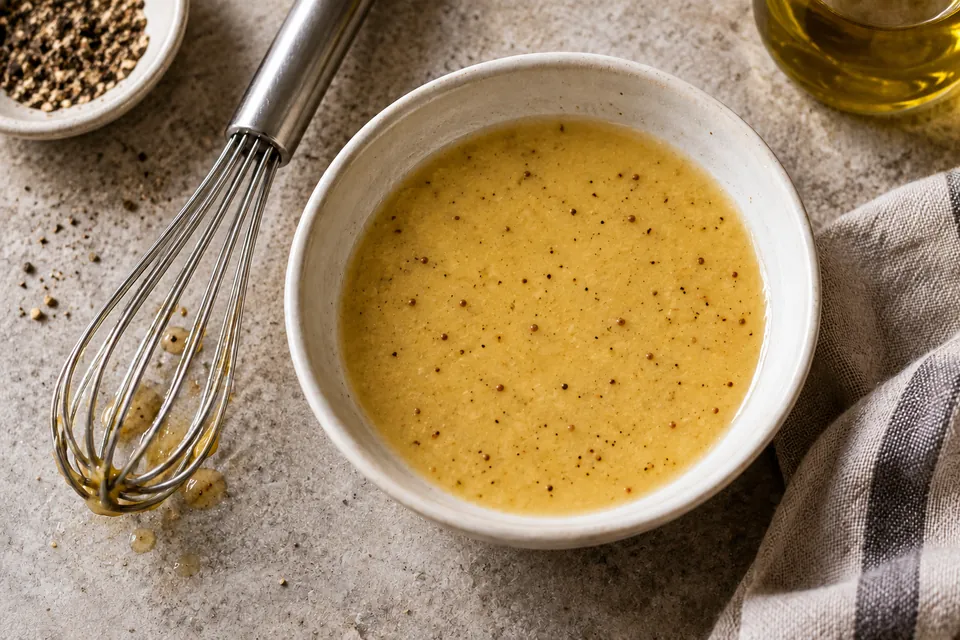
Identify the mixture first: a shaken vinaigrette, a mustard-assisted dressing, and a warm butter finish need different checks.
Look, listen, check
- An oil layer shows separation, not simply too much water.
- A temporary dressing can separate and still work after remixing.
- Thickness alone does not tell you how long a mixture will stay together.
In this guide
Use the idea
When a dressing or sauce looks oily, first identify the preparation. A vinaigrette that settles between uses and a butter-finished sauce separating during service are not interchangeable cases.
Look at what pours: is it reasonably uniform, or does oil arrive separately from a sharper or more concentrated watery layer? This observation helps choose a guide; it does not measure food safety.
The mechanism
An emulsion contains droplets dispersed through a liquid they do not ordinarily mix with. Guelph’s dairy-science glossary distinguishes oil-in-water from water-in-oil emulsions. A dressing’s watery phase includes vinegar or juice; it is not a separate ingredient that must always be poured from a water bottle.
Mixing creates a dispersion, but that does not promise permanence. Harvard’s Manoharan Lab uses shaken oil and vinegar to illustrate droplets followed by separation.
An ingredient that helps the mixture persist changes the practical result. ICE’s vinaigrette lesson identifies prepared Dijon mustard as one such ingredient. It still describes a dressing that can separate over time.
What to change
- If a plain vinaigrette remixes and coats the food long enough for serving, another shake may meet the goal.
- If a mustard-assisted dressing forms an immediate oil layer, pause oil additions and reconsider the method and proportions.
- If a warm butter finish loses cohesion, check available liquid rather than automatically boiling more water away.
- If the sauce remains cohesive but is simply hard to pour, use Sauce Is Too Thick.
Whisking is a means of mixing, not a guarantee that any amount of oil can be held by any base.
Worked comparisons
A dressing can pour easily while remaining evenly mixed long enough to dress a salad. A thick dressing can still release oil later. Those examples show why flow and stability deserve separate checks.
Likewise, a light butter-finished jus can be successful without the body of a concentrated stock sauce. Sauce Body makes that distinction useful at the stove.
Where it shows up
Vinaigrette gives the cold method; Finish a Sauce with Butter gives the warm finishing method. Serious Eats’ pan-sauce discussion describes water supporting dispersed butterfat, including sauces mixed during bubbling. Do not infer that every boil destroys every butter emulsion.
Limits
Butter-Finished Sauce Is Oily covers butter-finished liquid sauces. Its rescue does not establish a method for mayonnaise, hollandaise, scrambled egg sauces, curdled cream, or cheese.
A cohesive appearance also supplies no storage-life or doneness guarantee.