In the kitchen
Start with a clean pan, moderate preheating, and enough usable bottom area for your batch.
Look, listen, check
- The batch fits over the bottom rather than piling up.
- Brown fond is visible and can be assessed before deglazing.
- Discoloration after cleaning is not the same observation as food residue during cooking.
In this guide
What it is
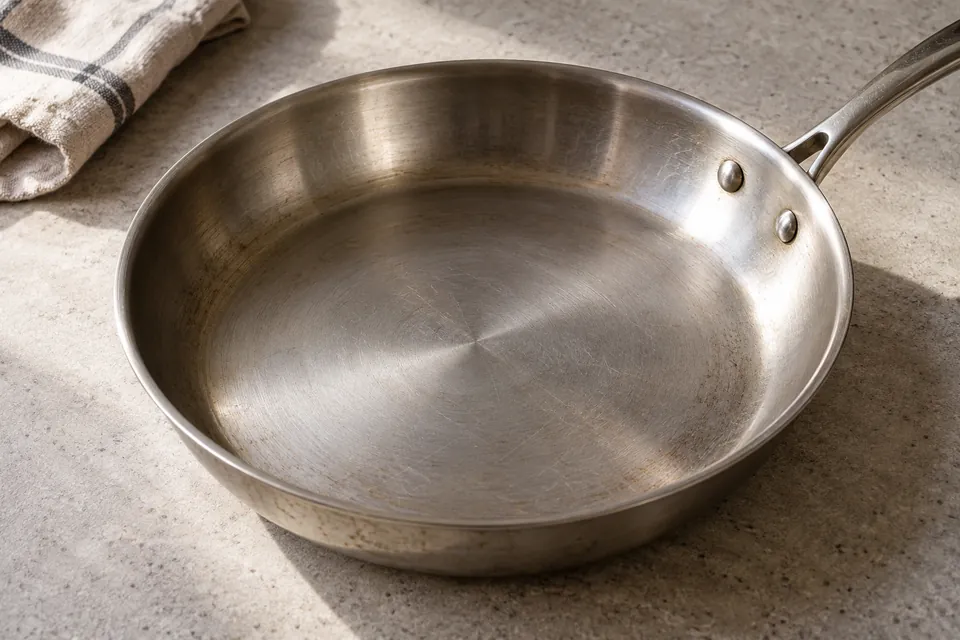
This page concerns an uncoated stainless-steel skillet. Some pans bond stainless steel to aluminum or copper; others use a layered base. “Stainless steel” alone does not specify the whole construction.
Material and thickness affect heat transfer, as OpenStax explains. Choose based on the actual pan rather than assuming all stainless skillets behave identically.
What it’s good at
It gives you a visible cooking surface for Sear and Sauté, then usable residue for Deglaze and Pan Sauce. Stainless steel also suits acidic sauce ingredients; All-Clad’s sauce guide discusses this application.
For a meal in progress, begin with a clean pan, moderate preheating, and a film of Cooking Oil. Watch the food and residue together.
What it’s bad at
It is not automatically nonstick. Delicate food can tear, and crowded batches can cook unevenly. If a turn resists, use Food Stuck to Pan rather than assuming the burner needs to go higher.
A smaller pan can still work with separate batches. Owning a larger pan does not resolve every heat-distribution problem.
Buying guidance
Look for enough flat cooking area for your usual batch, a manageable weight, and a handle you can grip securely. Check the manufacturer’s burner, oven, lid, and cleaning limits.
A coated skillet is a different tool with its own preheating and utensil rules. Choose it when the food and method benefit from that surface; do not apply this uncoated-pan routine automatically.
Related equipment
An Instant-Read Thermometer answers the internal-doneness question the pan cannot answer. Neither skillet color nor fond can substitute for that reading.
Techniques that use this
Searing establishes surface color. Sautéing manages smaller pieces. Deglazing recovers sound residue, and a pan sauce finishes the liquid.
For cleaning, let the pan cool and follow its care instructions. All-Clad cautions against thermal shock and leaving empty cookware over heat. Avoid making a universal oven-temperature promise from one manufacturer’s limit.