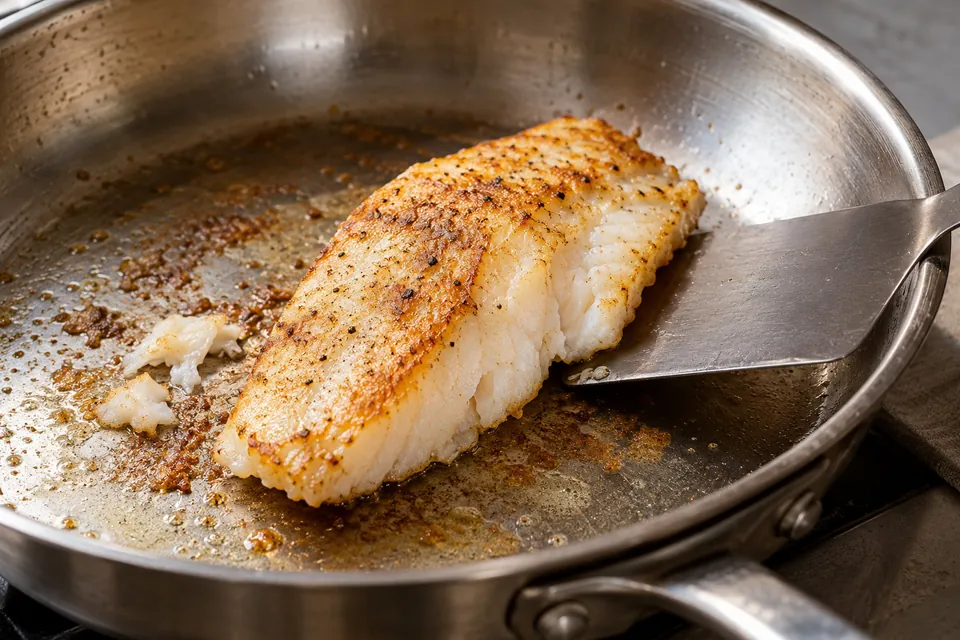
In the kitchen
Test an edge gently; wait briefly only for sturdy food that still needs browning and is not scorching.
Look, listen, check
- A spatula slides farther under the food with less resistance.
- Brown residue is different from a blackening crust.
- Some tearing may remain even after the food is cooked.
In this guide
What happened
The top moves but the underside stays behind. You may be turning too soon, working with a delicate surface, or encountering a poorly prepared pan.
This guide concerns uncoated stainless steel. Nonstick cookware has different utensil and heat limits; follow its instructions rather than applying a stainless-steel preheating routine.
How to fix it
- Stop pulling upward. Slide a suitable thin spatula under one edge and assess resistance.
- For sturdy food whose underside still needs browning, wait briefly and test again only if nothing is scorching. All-Clad’s stainless-steel guidance uses reduced sticking as a turning cue.
- If the residue is blackening or the smell is acrid, lower the heat or remove the pan from the burner. Waiting harder is not a rescue.
- Work gradually along the stuck area. For fragile food, accept some damage rather than repeatedly tearing it.
- After removing the food, decide whether the residue is usable. Deglaze it for sauce only if it has not scorched.
Release is not guaranteed. Sugary coatings, damaged surfaces, fragile fish or eggs, and food residue from an earlier batch can change the result. A piece that lifts easily may still need more cooking inside.
Why this happens
Stainless steel is not a nonstick surface. Food can adhere during cooking, and its attachment can change as the surface develops. Preparation, fat coverage, and turning technique all matter. A single instruction such as “make the pan hotter” cannot account for every case.
If the surface is already well browned, extra cooking may dry the food before it releases. Work with the utensil and accept some damage rather than escalating the heat.
How to prevent it next time
Start with a clean Stainless Steel Skillet and preheat it over low to moderate heat within its manufacturer’s limits. Spread a film of Cooking Oil over the working area, then give the food a manageable amount of space. Inspect during cooking rather than relying on a fixed waiting time.
For very delicate food, choose a pan and method suited to it. If you use nonstick, respect its specified heat and utensil limits.
Check meat independently with an Instant-Read Thermometer; USDA guidance rejects color as a safety indicator.
Related failures
Burnt Pan Drippings requires a flavor and heat reassessment, not more force.
See also
Sear explains contact and turning decisions. Once the food is out, sound brown residue can become a sauce even if some tearing occurred.